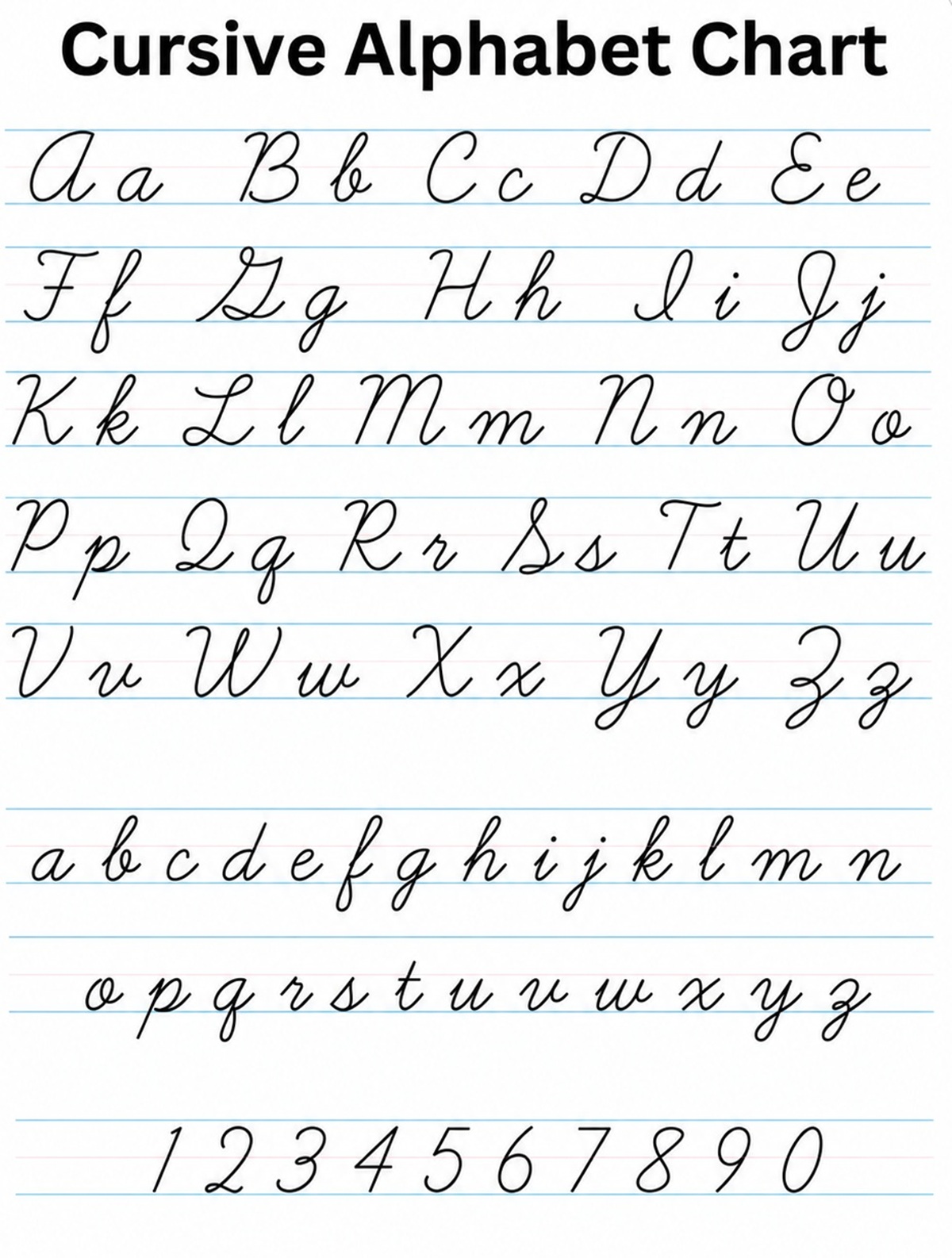
Learn to write the whole cursive alphabet, one letter at a time. Pick any letter below to see how to write it in capital and lowercase, watch a short stroke-by-stroke animation, and print a free practice worksheet. Below the letters you will find a quick guide to cursive writing: what it is, where it is taught, and the different styles you may come across.
Tap a letter to open its full guide and worksheet.
What is cursive writing?
Cursive is a style of handwriting in which the letters of a word are joined together in one flowing motion, rather than printed separately. The connected strokes let you write faster and with fewer pen lifts than print (manuscript) writing. Because the letters link, cursive has its own letter shapes, some quite different from their printed versions, which is why it helps to learn each letter on its own.
Where and when is cursive taught?
In the United States, cursive is usually introduced in the early elementary grades, most often around second and third grade, once children are comfortable with printing. Some states begin a little earlier or set a grade by which students should be fluent. For example, several state standards ask for cursive to begin by grade 3 and for students to write legibly in cursive by grade 5.
Is cursive required in schools?
There is no single national rule. When the Common Core standards were released in 2010, they focused on math and English and did not include cursive, so many schools dropped it. Since then, individual states have brought it back. As of 2024, roughly 25 states require cursive instruction in public schools, and more have bills in progress. States that mandate it include California, Texas, Louisiana, Ohio, North Carolina, Tennessee, South Carolina, New Jersey and Pennsylvania, among others, while some states leave the decision to individual districts.
The main cursive styles
Not all cursive looks the same. In American schools you will mostly meet two teaching styles, plus a few older ones:
| Style | What it is like |
|---|---|
| Zaner-Bloser | A traditional teaching script with clearly separate print and cursive alphabets and more formal, looped capitals. Common in many East Coast and Midwest schools. |
| D'Nealian | Designed to ease the jump from print to cursive: the print letters already have small tails, so fewer letters change shape when children start joining them. |
| Palmer / Spencerian | Older American penmanship methods. Spencerian is very ornate; the Palmer Method simplified it. You will see these in historical documents rather than modern classrooms. |
| Getty-Dubay (italic) | A simpler, semi-joined italic style used by some schools and adults who want neat, quick handwriting without heavy loops. |
The letters on this site follow standard, everyday cursive shapes, so they work whichever style your school uses. If your class follows a specific method, the stroke order stays broadly the same, only the flourishes on some capitals differ.
Why learn cursive?
Beyond being able to sign your name and read older handwriting, cursive has some practical benefits. Because it is written in one connected motion, it can be faster than print once mastered, and the flowing movement helps many children with letter formation and spelling. Being able to read cursive also matters for everyday life, from a grandparent's letter to historical records and legal documents.
How to use these pages
Each letter page shows the capital and lowercase form, a short stroke-order animation, a written step-by-step guide, common mistakes to avoid, example words, and a free printable worksheet with tracing lines. Start with the letters in your child's name, or simply work through the alphabet from A to Z.