Tthe complete collection of letters with accents on a single page. Every accented character from A to Z is here to copy and paste with one click, plus keyboard shortcuts for every device. For each letter you can jump to a dedicated page with the full ALT code list, language usage, example words and how to type it on Windows, Mac, iPhone and Android.
Click Letter to Copy & Paste
A With Accent
Small letter a
Capital letter A
á (a-acute) is one of the most widely used letters with accents. In Spanish it marks a stressed vowel, as in árbol (tree) and rápido (fast); in Portuguese, Czech, Hungarian and Icelandic it also signals stress or a long vowel. à (a-grave) appears in Italian (città, city; papà, dad), French (voilà, déjà) and Catalan (català).
â (a-circumflex) is common in French (château, pâte), Portuguese (câmara) and Romanian (mâine, tomorrow). ä (a-umlaut / a-diaeresis) is a core vowel in German (Mädchen, girl; Bäcker, baker), Finnish (äiti, mother) and Swedish. ã (a-tilde) is a nasal vowel in Portuguese (São Paulo, maçã, apple). å (a-ring) is a distinct letter in Danish, Norwegian and Swedish (Ångström, Åland, vår). ā (a-macron) marks a long vowel in Latin, Latvian, Māori and romanised Japanese. The ligature æ is a separate letter in Danish, Norwegian and Icelandic (Æble) and appears in English loanwords like encyclopædia. These are among the most searched accent letters because names and place names rely on them.
B With Accent
Small letter b
Capital letter B
B rarely takes a diacritic in major European languages. ḃ (b-dot) appears in older Irish orthography, ɓ (b-hook) is used in several African languages such as Hausa and Fula, and ƀ (b-stroke) appears in some transliteration systems. These are uncommon letters with accents mostly needed for linguistics and African names.
C With Accent
Small letter c
Capital letter C
ç (c-cedilla) is the most important accented C. It gives a soft “s” sound before hard vowels in French (garçon, boy; façade), Portuguese (coração, heart; maçã, apple) and Catalan, and it is a full letter in Turkish (çay, tea) and Azerbaijani. ć (c-acute) is Polish (ćma) and Croatian/Serbian. č (c-caron) sounds like “ch” in Czech, Slovak, Slovenian and Croatian (Čech, počítač, computer). ĉ (c-circumflex) is Esperanto. These accent letters are copied constantly for names like François and Novák.
D With Accent
Small letter d
Capital letter D
đ (d-stroke) is a separate letter in Croatian, Serbian (Latin) and Vietnamese (đồng, the currency). ď (d-caron) is Czech and Slovak (ďábel, devil). The letter ð (eth) is used in Icelandic and Faroese for a “th” sound (Óðinn). These letters with accent marks are needed for names from the Balkans, Iceland and Vietnam.
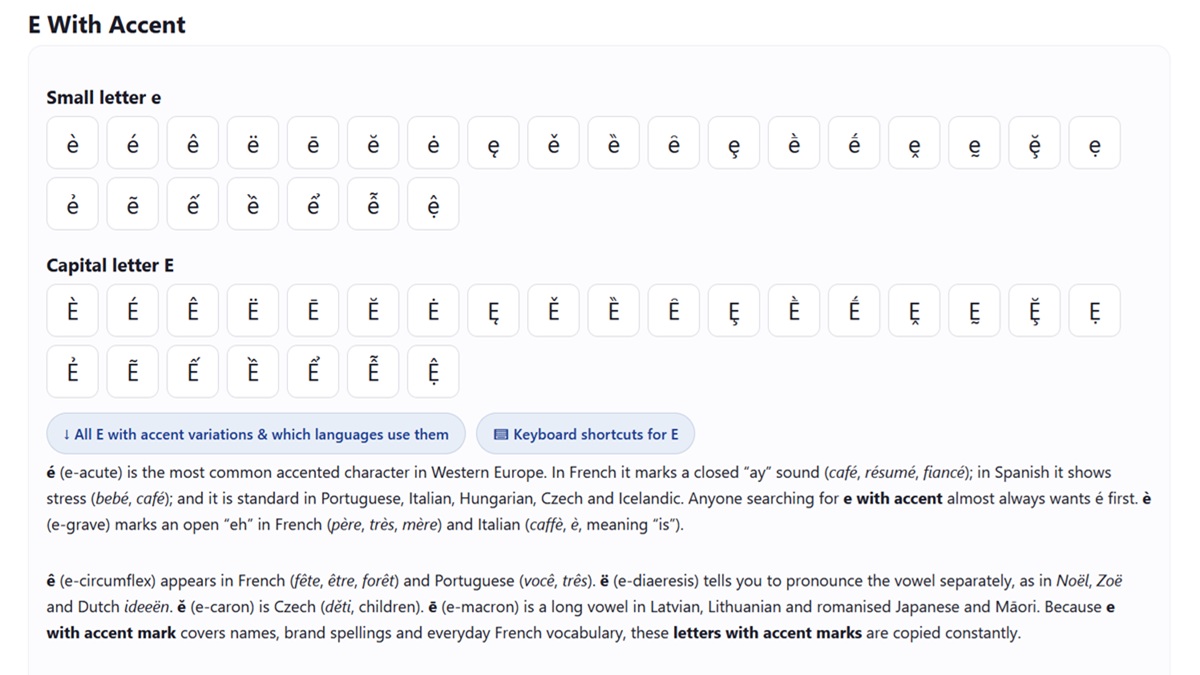
E With Accent
Small letter e
Capital letter E
é (e-acute) is the most common accented character in Western Europe. In French it marks a closed “ay” sound (café, résumé, fiancé); in Spanish it shows stress (bebé, café); and it is standard in Portuguese, Italian, Hungarian, Czech and Icelandic. Anyone searching for e with accent almost always wants é first. è (e-grave) marks an open “eh” in French (père, très, mère) and Italian (caffè, è, meaning “is”).
ê (e-circumflex) appears in French (fête, être, forêt) and Portuguese (você, três). ë (e-diaeresis) tells you to pronounce the vowel separately, as in Noël, Zoë and Dutch ideeën. ě (e-caron) is Czech (děti, children). ē (e-macron) is a long vowel in Latvian, Lithuanian and romanised Japanese and Māori. Because e with accent mark covers names, brand spellings and everyday French vocabulary, these letters with accent marks are copied constantly.
F With Accent
Small letter f
Capital letter F
F takes almost no accents in everyday writing. ḟ (f-dot) belongs to old Irish spelling, and ƒ (f-hook) is best known as the florin currency symbol and in phonetic notation. These are rare accent letters.
G With Accent
Small letter g
Capital letter G
ğ (g-breve, the “soft g”) is a Turkish letter that lengthens the preceding vowel (dağ, mountain; Erdoğan). ĝ is Esperanto, ģ is Latvian, and ǧ appears in some transliteration systems. When people search letters with accents for Turkish names, ğ is usually the one they need.
H With Accent
Small letter h
Capital letter H
ĥ (h-circumflex) is Esperanto, ħ (h-bar) is a full letter in Maltese (ħal) and also the symbol for the reduced Planck constant in physics, and ḥ (h-dot) is common in Arabic and Hebrew transliteration. These letters with accent marks mainly serve Maltese, science and romanisation.
I With Accent
Small letter i
Capital letter I
í (i-acute) marks a stressed vowel in Spanish (día, day; sí, yes), Portuguese, Czech, Hungarian and Icelandic. ì (i-grave) is Italian (così, lunedì, Monday). î (i-circumflex) appears in French (île, island; maître) and Romanian (în, in). ï (i-diaeresis) signals a separately pronounced vowel in French (naïve, maïs, corn) and English loanwords. ī (i-macron) is a long vowel in Latvian, Māori and romanised Japanese. The dotless ı and dotted İ are separate letters in Turkish and Azerbaijani, which is why Turkish names often trip up English keyboards.
J With Accent
Small letter j
Capital letter J
ĵ (j-circumflex) is used in Esperanto, and ǰ (j-caron) appears in phonetic transcription and some romanisation systems. Accented J is otherwise very rare among letters with accents.
K With Accent
Small letter k
Capital letter K
ķ (k-cedilla) is Latvian, ǩ (k-caron) is used in Skolt Sami, and ƙ (k-hook) appears in several African languages. These are specialist accent letters.
L With Accent
Small letter l
Capital letter L
ł (l-stroke) is a Polish letter pronounced like English “w” (Łódź, Wałęsa, mały, small). ľ (l-caron) and ĺ (l-acute) are Slovak, and ļ (l-cedilla) is Latvian. ł is one of the more surprising letters with accents for English speakers because it does not sound like an L at all.
M With Accent
Small letter m
Capital letter M
M is one of the few letters with almost no accented forms in living orthographies. ṁ (m-dot) appears in old Irish spelling and ḿ (m-acute) in some Slavic transliteration. Genuinely rare letters with accents.
N With Accent
Small letter n
Capital letter N
ñ (n-tilde) is the signature letter of Spanish, standing for the “ny” sound in español, niño (child), mañana (tomorrow) and señor. It is a separate letter of the Spanish alphabet, not just an accented N, and it also appears in Galician, Basque and Filipino. ń (n-acute) is Polish (koń, horse). ň (n-caron) is Czech and Slovak (kůň). ņ (n-cedilla) is Latvian. ñ is one of the single most searched letters with accents because of Spanish names and words.
O With Accent
Small letter o
Capital letter O
ó (o-acute) shows stress in Spanish (corazón, heart), Polish (where it sounds like “u”, as in Kraków), Portuguese, Czech and Hungarian. ò (o-grave) is Italian (però, but) and Catalan. ô (o-circumflex) appears in French (hôtel, côte) and Portuguese (avô, grandfather). ö (o-umlaut) is a full vowel in German (schön, beautiful; Köln, Cologne), Swedish, Finnish, Hungarian and Turkish.
õ (o-tilde) is nasal in Portuguese (João, limões, lemons) and a distinct vowel in Estonian. ø (o-slash) is a separate letter in Danish and Norwegian (Ørsted, søster, sister). ō (o-macron) marks a long vowel in romanised Japanese (Tōkyō, Ōsaka), Māori and Latin. The ligature œ is used in French (cœur, heart; œuf, egg). O has one of the largest sets of accent letters, which is why it appears so often in letters with accents searches for names and places.
P With Accent
Small letter p
Capital letter P
ṗ (p-dot) is used in old Irish orthography and ᵽ / ƥ appear in phonetic and African-language contexts. Accented P is uncommon among accent letters.
Q With Accent
Q has no accented forms in standard alphabets.
Q has essentially no accented forms in standard European alphabets, which is why this group is the smallest. The rare ɋ appears only in specialist phonetic notation. If you were looking for Q among letters with accents, it simply does not take diacritics in normal writing.
R With Accent
Small letter r
Capital letter R
ř (r-caron) is a famously difficult Czech sound found in the composer Dvořák and řeka (river). ŕ (r-acute) is Slovak, and ŗ (r-cedilla) is Latvian. These are specialist accent letters but essential for Czech and Slovak names.
S With Accent
Small letter s
Capital letter S
š (s-caron) sounds like “sh” and is used across Czech, Slovak, Slovenian, Croatian, Latvian, Lithuanian, Estonian and Finnish loanwords (Škoda, Tomáš). ś (s-acute) is Polish (Śląsk, Silesia). ş (s-cedilla) is Turkish (şeker, sugar) and Romanian (şi, and). ș (s-comma) is the correct Romanian form. The sharp S, ß (eszett), is a German letter that stands for a double “s” (Straße, street; Fußball). These letters with accent marks show up in surnames and place names throughout Central Europe.
T With Accent
Small letter t
Capital letter T
ť (t-caron) is Czech and Slovak (ťava, camel). ţ (t-cedilla) and ț (t-comma) are Romanian (ț sounds like “ts”, as in București, Bucharest). The letter þ (thorn) is Icelandic, standing for the “th” in Þór (Thor). These accent letters appear in Romanian and Icelandic names.
U With Accent
Small letter u
Capital letter U
ú (u-acute) marks stress in Spanish (música), Portuguese, Czech, Icelandic and Irish (Dún). ù (u-grave) is Italian (più, more) and French (où, where). û (u-circumflex) is French (sûr, sure; coût, cost). ü (u-umlaut / u-diaeresis) is a core vowel in German (über, Müller, Zürich), Hungarian and Turkish, and in Spanish it appears in pingüino to show the u is pronounced. When people look up u with accent, ü and ú are the two they usually need.
ū (u-macron) is a long vowel in romanised Japanese, Latvian, Lithuanian and Māori. ů (u-ring) is specifically Czech (dům, house). German also uses the special forms ǘ ǚ ǜ ǖ for tone marking in Chinese Pinyin (lǜ, green; nǚ, woman). These letters with accent marks matter for German brand names and Pinyin study alike.
V With Accent
Small letter v
Capital letter V
ṽ (v-tilde) and ṿ (v-dot) appear mainly in transliteration of Indian and other languages, and ʋ is a phonetic symbol. Accented V is rare among everyday accent letters.
W With Accent
Small letter w
Capital letter W
ŵ (w-circumflex) and ẃ / ẁ (w-acute / w-grave) are used in Welsh, where W can act as a vowel (ŵy, egg). ẅ (w-diaeresis) is also Welsh. These letters with accent marks are almost exclusively Welsh.
X With Accent
Small letter x
Capital letter X
X takes diacritics only in specialist contexts. ẋ (x-dot) and ẍ (x-diaeresis) appear in transliteration and phonetic notation. There are essentially no common accent letters based on X.
Y With Accent
Small letter y
Capital letter Y
ý (y-acute) marks a long vowel in Czech and Slovak (býk, bull) and appears in Icelandic and Welsh. ÿ (y-diaeresis) is rare but shows up in French surnames such as Aÿ and in Dutch. ŷ (y-circumflex) is Welsh. These are less common accent letters but still needed for proper names.
Z With Accent
Small letter z
Capital letter Z
ž (z-caron) is a “zh” sound used in Czech, Slovak, Slovenian, Croatian, Latvian, Lithuanian and Estonian (Dvořák region names, žaba, frog). ź (z-acute) and ż (z-dot) are both Polish and contrast in pronunciation (źle, badly; żaba, frog). These accent letters are essential for Slavic names.
Keyboard shortcuts for accent letters (Microsoft Word)
These keyboard shortcuts work in Microsoft Word and most Office apps. Hold the key combination, release it, then press the base letter. For device-specific methods (Mac, iPhone, Android, Linux) open any letter’s dedicated page.
| Accent letters | Key combination |
|---|---|
| à, è, ì, ò, ù (and capitals) | Ctrl + ` (grave), then the letter |
| á, é, í, ó, ú, ý (and capitals) | Ctrl + ' (apostrophe), then the letter |
| â, ê, î, ô, û (and capitals) | Ctrl + Shift + ^ (caret), then the letter |
| ä, ë, ï, ö, ü, ÿ (and capitals) | Ctrl + Shift + : (colon), then the letter |
| ã, ñ, õ (and capitals) | Ctrl + Shift + ~ (tilde), then the letter |
| ¿ | Alt + Ctrl + Shift + ? |
| ¡ | Alt + Ctrl + Shift + ! |
| ß | Ctrl + Shift + &, then s |
| å, Å | Ctrl + Shift + @, then a or A |
| æ, Æ | Ctrl + Shift + &, then a or A |
| œ, Œ | Ctrl + Shift + &, then o or O |
| ç, Ç | Ctrl + ,, then c or C |
| ð, Ð | Ctrl + ', then d or D |
| ø, Ø | Ctrl + /, then o or O |
Types of accent marks (diacritics)
An accent letter is a base letter plus a small mark called a diacritic. The most common marks are:
Acute ( ´ )
Marks stress or a higher/closed vowel, as in café and résumé. Common in Spanish, Portuguese, French, Czech, Hungarian and Icelandic.
Grave ( ` )
Marks a lower or more open vowel, as in French père and Italian caffè.
Circumflex ( ˆ )
Shows a change in vowel quality or a dropped historical letter, as in French hôtel (once “hostel”).
Diaeresis / umlaut ( ¨ )
Tells you to pronounce a vowel separately (Noël) or shifts the vowel, as in German über.
Tilde ( ˜ )
Nasalises or palatalises, as in Spanish ñ (español) and Portuguese ã (São Paulo).
Cedilla ( ¸ )
Softens C to an “s”, as in French garçon and Portuguese coração.
How to type letters with accents on any device
The quickest method depends on your device. Every letter’s dedicated page gives the exact codes for that letter; here is the general method for each platform.
Windows
Hold Alt and type the number from the ALT code table on the numeric keypad (Num Lock on), then release Alt. In Word you can also type the Unicode hex and press Alt + X. Or press Win + . for the symbol panel, or enable the US-International keyboard.
Mac
Hold Option and an accent key, then the letter — e.g. Option + e then e for é, Option + ` then e for è. Or hold the base letter for a pop-up menu of accents.
iPhone & iPad
Press and hold the base letter on the keyboard, then slide to the accented version and release.
Android
On Gboard or SwiftKey, press and hold the base letter, then slide to the accent you want.
Linux
Press Ctrl + Shift + U, type the Unicode hex, then Enter; or use a Compose key.
Excel & Google Sheets
Use =UNICHAR(233) for é and the matching decimal for other characters.
Languages, examples and ALT codes for every letter
Below is the full breakdown for each letter: which languages use each variant, example words, and the complete ALT code list. Open a letter’s dedicated page for per-device typing and technical codes.
A with accent — languages & ALT codes
á (a-acute) is one of the most widely used letters with accents. In Spanish it marks a stressed vowel, as in árbol (tree) and rápido (fast); in Portuguese, Czech, Hungarian and Icelandic it also signals stress or a long vowel. à (a-grave) appears in Italian (città, city; papà, dad), French (voilà, déjà) and Catalan (català).
â (a-circumflex) is common in French (château, pâte), Portuguese (câmara) and Romanian (mâine, tomorrow). ä (a-umlaut / a-diaeresis) is a core vowel in German (Mädchen, girl; Bäcker, baker), Finnish (äiti, mother) and Swedish. ã (a-tilde) is a nasal vowel in Portuguese (São Paulo, maçã, apple). å (a-ring) is a distinct letter in Danish, Norwegian and Swedish (Ångström, Åland, vår). ā (a-macron) marks a long vowel in Latin, Latvian, Māori and romanised Japanese. The ligature æ is a separate letter in Danish, Norwegian and Icelandic (Æble) and appears in English loanwords like encyclopædia. These are among the most searched accent letters because names and place names rely on them.
| ALT code | Symbol | Description | Used in (languages) |
|---|---|---|---|
| ALT 133 | à | Lowercase letter A with grave | Italian, French, Catalan |
| ALT 160 | á | Lowercase letter A with acute | Spanish, Portuguese, Italian, Czech, Slovak, Hungarian, Polish, Icelandic |
| ALT 131 | â | Lowercase letter A with circumflex | French, Portuguese, Esperanto |
| ALT 0227 | ã | Lowercase letter A with tilde | Portuguese, Estonian |
| ALT 132 | ä | Lowercase letter A with diaeresis | German, Swedish, Finnish, Estonian, Slovak |
| ALT 134 | å | Lowercase letter A with ring above | Danish, Norwegian, Swedish |
| ALT 257 | ā | Lowercase letter A with macron | Latvian, Lithuanian, Māori, Latin, romanized Japanese |
| ALT 259 | ă | Lowercase letter A with breve | Turkish, Romanian, Esperanto |
| ALT 261 | ą | Lowercase letter A with ogonek | Polish, Lithuanian |
| ALT 462 | ǎ | Lowercase letter A with caron | Czech, Slovak, Slovenian, Croatian, Latvian, Lithuanian |
| ALT 479 | ǟ | Lowercase letter A with diaeresis and macron | French, Dutch, German |
| ALT 481 | ǡ | Lowercase letter A with dot above and macron | Irish (old orthography), Maltese, Lithuanian |
| ALT 507 | ǻ | Lowercase letter A with ring above and acute | Danish, Norwegian, Swedish, Czech |
| ALT 513 | ȁ | Lowercase letter A with double grave | Croatian, Slovenian (linguistics) |
| ALT 515 | ȃ | Lowercase letter A with inverted breve | Croatian, Slovenian (linguistics) |
| ALT 551 | ȧ | Lowercase letter A with dot above | Irish (old orthography), Maltese, Lithuanian |
| ALT 7681 | ḁ | Lowercase letter A with ring below | transliteration / phonetic notation |
| ALT 7841 | ạ | Lowercase letter A with dot below | Vietnamese, transliteration |
| ALT 7843 | ả | Lowercase letter A with hook above | Vietnamese |
| ALT 7845 | ấ | Lowercase letter A with circumflex and acute | French, Portuguese, Esperanto |
| ALT 7847 | ầ | Lowercase letter A with circumflex and grave | French, Portuguese, Esperanto |
| ALT 7849 | ẩ | Lowercase letter A with circumflex and hook above | Vietnamese |
| ALT 7851 | ẫ | Lowercase letter A with circumflex and tilde | French, Portuguese, Esperanto |
| ALT 7853 | ậ | Lowercase letter A with circumflex and dot below | Vietnamese |
| ALT 7855 | ắ | Lowercase letter A with breve and acute | Turkish, Romanian, Esperanto |
| ALT 7857 | ằ | Lowercase letter A with breve and grave | Turkish, Romanian, Esperanto |
| ALT 7859 | ẳ | Lowercase letter A with breve and hook above | Vietnamese |
| ALT 7861 | ẵ | Lowercase letter A with breve and tilde | Turkish, Romanian, Esperanto |
| ALT 7863 | ặ | Lowercase letter A with breve and dot below | Vietnamese |
| ALT 0192 | À | Capital letter A with grave | Italian, French, Catalan |
| ALT 0193 | Á | Capital letter A with acute | Spanish, Portuguese, Italian, Czech, Slovak, Hungarian, Polish, Icelandic |
| ALT 0194 | Â | Capital letter A with circumflex | French, Portuguese, Esperanto |
| ALT 0195 | Ã | Capital letter A with tilde | Portuguese, Estonian |
| ALT 142 | Ä | Capital letter A with diaeresis | German, Swedish, Finnish, Estonian, Slovak |
| ALT 143 | Å | Capital letter A with ring above | Danish, Norwegian, Swedish |
| ALT 256 | Ā | Capital letter A with macron | Latvian, Lithuanian, Māori, Latin, romanized Japanese |
| ALT 258 | Ă | Capital letter A with breve | Turkish, Romanian, Esperanto |
| ALT 260 | Ą | Capital letter A with ogonek | Polish, Lithuanian |
| ALT 461 | Ǎ | Capital letter A with caron | Czech, Slovak, Slovenian, Croatian, Latvian, Lithuanian |
| ALT 478 | Ǟ | Capital letter A with diaeresis and macron | French, Dutch, German |
| ALT 480 | Ǡ | Capital letter A with dot above and macron | Irish (old orthography), Maltese, Lithuanian |
| ALT 506 | Ǻ | Capital letter A with ring above and acute | Danish, Norwegian, Swedish, Czech |
| ALT 512 | Ȁ | Capital letter A with double grave | Croatian, Slovenian (linguistics) |
| ALT 514 | Ȃ | Capital letter A with inverted breve | Croatian, Slovenian (linguistics) |
| ALT 550 | Ȧ | Capital letter A with dot above | Irish (old orthography), Maltese, Lithuanian |
| ALT 7680 | Ḁ | Capital letter A with ring below | transliteration / phonetic notation |
| ALT 7840 | Ạ | Capital letter A with dot below | Vietnamese, transliteration |
| ALT 7842 | Ả | Capital letter A with hook above | Vietnamese |
| ALT 7844 | Ấ | Capital letter A with circumflex and acute | French, Portuguese, Esperanto |
| ALT 7846 | Ầ | Capital letter A with circumflex and grave | French, Portuguese, Esperanto |
| ALT 7848 | Ẩ | Capital letter A with circumflex and hook above | Vietnamese |
| ALT 7850 | Ẫ | Capital letter A with circumflex and tilde | French, Portuguese, Esperanto |
| ALT 7852 | Ậ | Capital letter A with circumflex and dot below | Vietnamese |
| ALT 7854 | Ắ | Capital letter A with breve and acute | Turkish, Romanian, Esperanto |
| ALT 7856 | Ằ | Capital letter A with breve and grave | Turkish, Romanian, Esperanto |
| ALT 7858 | Ẳ | Capital letter A with breve and hook above | Vietnamese |
| ALT 7860 | Ẵ | Capital letter A with breve and tilde | Turkish, Romanian, Esperanto |
| ALT 7862 | Ặ | Capital letter A with breve and dot below | Vietnamese |
Open the full A with accent page →
B with accent — languages & ALT codes
B rarely takes a diacritic in major European languages. ḃ (b-dot) appears in older Irish orthography, ɓ (b-hook) is used in several African languages such as Hausa and Fula, and ƀ (b-stroke) appears in some transliteration systems. These are uncommon letters with accents mostly needed for linguistics and African names.
| ALT code | Symbol | Description | Used in (languages) |
|---|---|---|---|
| ALT 7683 | ḃ | Lowercase letter B with dot above | Irish (old orthography) |
| ALT 7685 | ḅ | Lowercase letter B with dot below | Rare — transliteration / phonetic notation |
| ALT 7687 | ḇ | Lowercase letter B with line below | Rare — transliteration / phonetic notation |
| ALT 7682 | Ḃ | Capital letter B with dot above | Irish (old orthography) |
| ALT 7684 | Ḅ | Capital letter B with dot below | Rare — transliteration / phonetic notation |
| ALT 7686 | Ḇ | Capital letter B with line below | Rare — transliteration / phonetic notation |
Open the full B with accent page →
C with accent — languages & ALT codes
ç (c-cedilla) is the most important accented C. It gives a soft “s” sound before hard vowels in French (garçon, boy; façade), Portuguese (coração, heart; maçã, apple) and Catalan, and it is a full letter in Turkish (çay, tea) and Azerbaijani. ć (c-acute) is Polish (ćma) and Croatian/Serbian. č (c-caron) sounds like “ch” in Czech, Slovak, Slovenian and Croatian (Čech, počítač, computer). ĉ (c-circumflex) is Esperanto. These accent letters are copied constantly for names like François and Novák.
| ALT code | Symbol | Description | Used in (languages) |
|---|---|---|---|
| ALT 135 | ç | Lowercase letter C with cedilla | French, Portuguese, Catalan, Turkish, Azerbaijani |
| ALT 263 | ć | Lowercase letter C with acute | Polish, Croatian, Serbian |
| ALT 265 | ĉ | Lowercase letter C with circumflex | Esperanto |
| ALT 267 | ċ | Lowercase letter C with dot above | Maltese, Irish (old orthography) |
| ALT 269 | č | Lowercase letter C with caron | Czech, Slovak, Slovenian, Croatian, Latvian, Lithuanian |
| ALT 7689 | ḉ | Lowercase letter C with cedilla and acute | French, Portuguese, Turkish, Latvian, Romanian |
| ALT 0199 | Ç | Capital letter C with cedilla | French, Portuguese, Catalan, Turkish, Azerbaijani |
| ALT 262 | Ć | Capital letter C with acute | Polish, Croatian, Serbian |
| ALT 264 | Ĉ | Capital letter C with circumflex | Esperanto |
| ALT 266 | Ċ | Capital letter C with dot above | Maltese, Irish (old orthography) |
| ALT 268 | Č | Capital letter C with caron | Czech, Slovak, Slovenian, Croatian, Latvian, Lithuanian |
| ALT 7688 | Ḉ | Capital letter C with cedilla and acute | French, Portuguese, Turkish, Latvian, Romanian |
Open the full C with accent page →
D with accent — languages & ALT codes
đ (d-stroke) is a separate letter in Croatian, Serbian (Latin) and Vietnamese (đồng, the currency). ď (d-caron) is Czech and Slovak (ďábel, devil). The letter ð (eth) is used in Icelandic and Faroese for a “th” sound (Óðinn). These letters with accent marks are needed for names from the Balkans, Iceland and Vietnam.
| ALT code | Symbol | Description | Used in (languages) |
|---|---|---|---|
| ALT 271 | ď | Lowercase letter D with caron | Czech, Slovak |
| ALT 7691 | ḋ | Lowercase letter D with dot above | Irish (old orthography) |
| ALT 7693 | ḍ | Lowercase letter D with dot below | Rare — transliteration / phonetic notation |
| ALT 7695 | ḏ | Lowercase letter D with line below | Rare — transliteration / phonetic notation |
| ALT 7697 | ḑ | Lowercase letter D with cedilla | Rare — transliteration / phonetic notation |
| ALT 7699 | ḓ | Lowercase letter D with circumflex below | Rare — transliteration / phonetic notation |
| ALT 270 | Ď | Capital letter D with caron | Czech, Slovak |
| ALT 7690 | Ḋ | Capital letter D with dot above | Irish (old orthography) |
| ALT 7692 | Ḍ | Capital letter D with dot below | Rare — transliteration / phonetic notation |
| ALT 7694 | Ḏ | Capital letter D with line below | Rare — transliteration / phonetic notation |
| ALT 7696 | Ḑ | Capital letter D with cedilla | Rare — transliteration / phonetic notation |
| ALT 7698 | Ḓ | Capital letter D with circumflex below | Rare — transliteration / phonetic notation |
Open the full D with accent page →
E with accent — languages & ALT codes
é (e-acute) is the most common accented character in Western Europe. In French it marks a closed “ay” sound (café, résumé, fiancé); in Spanish it shows stress (bebé, café); and it is standard in Portuguese, Italian, Hungarian, Czech and Icelandic. Anyone searching for e with accent almost always wants é first. è (e-grave) marks an open “eh” in French (père, très, mère) and Italian (caffè, è, meaning “is”).
ê (e-circumflex) appears in French (fête, être, forêt) and Portuguese (você, três). ë (e-diaeresis) tells you to pronounce the vowel separately, as in Noël, Zoë and Dutch ideeën. ě (e-caron) is Czech (děti, children). ē (e-macron) is a long vowel in Latvian, Lithuanian and romanised Japanese and Māori. Because e with accent mark covers names, brand spellings and everyday French vocabulary, these letters with accent marks are copied constantly.
| ALT code | Symbol | Description | Used in (languages) |
|---|---|---|---|
| ALT 138 | è | Lowercase letter E with grave | Italian, French, Catalan |
| ALT 130 | é | Lowercase letter E with acute | French, Spanish, Portuguese, Italian, Hungarian, Czech, Icelandic |
| ALT 136 | ê | Lowercase letter E with circumflex | French, Portuguese, Esperanto |
| ALT 137 | ë | Lowercase letter E with diaeresis | French, Dutch, German |
| ALT 275 | ē | Lowercase letter E with macron | Latvian, Lithuanian, Māori, Latin, romanized Japanese |
| ALT 277 | ĕ | Lowercase letter E with breve | Turkish, Romanian, Esperanto |
| ALT 279 | ė | Lowercase letter E with dot above | Irish (old orthography), Maltese, Lithuanian |
| ALT 281 | ę | Lowercase letter E with ogonek | Polish, Lithuanian |
| ALT 283 | ě | Lowercase letter E with caron | Czech, Slovak, Slovenian, Croatian, Latvian, Lithuanian |
| ALT 517 | ȅ | Lowercase letter E with double grave | Croatian, Slovenian (linguistics) |
| ALT 519 | ȇ | Lowercase letter E with inverted breve | Croatian, Slovenian (linguistics) |
| ALT 553 | ȩ | Lowercase letter E with cedilla | French, Portuguese, Turkish, Latvian, Romanian |
| ALT 7701 | ḕ | Lowercase letter E with macron and grave | Latvian, Lithuanian, Māori, Latin, romanized Japanese |
| ALT 7703 | ḗ | Lowercase letter E with macron and acute | Latvian, Lithuanian, Māori, Latin, romanized Japanese |
| ALT 7705 | ḙ | Lowercase letter E with circumflex below | transliteration / phonetic notation |
| ALT 7707 | ḛ | Lowercase letter E with tilde below | transliteration / phonetic notation |
| ALT 7709 | ḝ | Lowercase letter E with cedilla and breve | French, Portuguese, Turkish, Latvian, Romanian |
| ALT 7865 | ẹ | Lowercase letter E with dot below | Vietnamese, transliteration |
| ALT 7867 | ẻ | Lowercase letter E with hook above | Vietnamese |
| ALT 7869 | ẽ | Lowercase letter E with tilde | Portuguese, Estonian |
| ALT 7871 | ế | Lowercase letter E with circumflex and acute | French, Portuguese, Esperanto |
| ALT 7873 | ề | Lowercase letter E with circumflex and grave | French, Portuguese, Esperanto |
| ALT 7875 | ể | Lowercase letter E with circumflex and hook above | Vietnamese |
| ALT 7877 | ễ | Lowercase letter E with circumflex and tilde | French, Portuguese, Esperanto |
| ALT 7879 | ệ | Lowercase letter E with circumflex and dot below | Vietnamese |
| ALT 0200 | È | Capital letter E with grave | Italian, French, Catalan |
| ALT 144 | É | Capital letter E with acute | French, Spanish, Portuguese, Italian, Hungarian, Czech, Icelandic |
| ALT 0202 | Ê | Capital letter E with circumflex | French, Portuguese, Esperanto |
| ALT 0203 | Ë | Capital letter E with diaeresis | French, Dutch, German |
| ALT 274 | Ē | Capital letter E with macron | Latvian, Lithuanian, Māori, Latin, romanized Japanese |
| ALT 276 | Ĕ | Capital letter E with breve | Turkish, Romanian, Esperanto |
| ALT 278 | Ė | Capital letter E with dot above | Irish (old orthography), Maltese, Lithuanian |
| ALT 280 | Ę | Capital letter E with ogonek | Polish, Lithuanian |
| ALT 282 | Ě | Capital letter E with caron | Czech, Slovak, Slovenian, Croatian, Latvian, Lithuanian |
| ALT 516 | Ȅ | Capital letter E with double grave | Croatian, Slovenian (linguistics) |
| ALT 518 | Ȇ | Capital letter E with inverted breve | Croatian, Slovenian (linguistics) |
| ALT 552 | Ȩ | Capital letter E with cedilla | French, Portuguese, Turkish, Latvian, Romanian |
| ALT 7700 | Ḕ | Capital letter E with macron and grave | Latvian, Lithuanian, Māori, Latin, romanized Japanese |
| ALT 7702 | Ḗ | Capital letter E with macron and acute | Latvian, Lithuanian, Māori, Latin, romanized Japanese |
| ALT 7704 | Ḙ | Capital letter E with circumflex below | transliteration / phonetic notation |
| ALT 7706 | Ḛ | Capital letter E with tilde below | transliteration / phonetic notation |
| ALT 7708 | Ḝ | Capital letter E with cedilla and breve | French, Portuguese, Turkish, Latvian, Romanian |
| ALT 7864 | Ẹ | Capital letter E with dot below | Vietnamese, transliteration |
| ALT 7866 | Ẻ | Capital letter E with hook above | Vietnamese |
| ALT 7868 | Ẽ | Capital letter E with tilde | Portuguese, Estonian |
| ALT 7870 | Ế | Capital letter E with circumflex and acute | French, Portuguese, Esperanto |
| ALT 7872 | Ề | Capital letter E with circumflex and grave | French, Portuguese, Esperanto |
| ALT 7874 | Ể | Capital letter E with circumflex and hook above | Vietnamese |
| ALT 7876 | Ễ | Capital letter E with circumflex and tilde | French, Portuguese, Esperanto |
| ALT 7878 | Ệ | Capital letter E with circumflex and dot below | Vietnamese |
Open the full E with accent page →
F with accent — languages & ALT codes
F takes almost no accents in everyday writing. ḟ (f-dot) belongs to old Irish spelling, and ƒ (f-hook) is best known as the florin currency symbol and in phonetic notation. These are rare accent letters.
| ALT code | Symbol | Description | Used in (languages) |
|---|---|---|---|
| ALT 7711 | ḟ | Lowercase letter F with dot above | Irish (old orthography) |
| ALT 7710 | Ḟ | Capital letter F with dot above | Irish (old orthography) |
Open the full F with accent page →
G with accent — languages & ALT codes
ğ (g-breve, the “soft g”) is a Turkish letter that lengthens the preceding vowel (dağ, mountain; Erdoğan). ĝ is Esperanto, ģ is Latvian, and ǧ appears in some transliteration systems. When people search letters with accents for Turkish names, ğ is usually the one they need.
| ALT code | Symbol | Description | Used in (languages) |
|---|---|---|---|
| ALT 285 | ĝ | Lowercase letter G with circumflex | Esperanto |
| ALT 287 | ğ | Lowercase letter G with breve | Turkish, Azerbaijani |
| ALT 289 | ġ | Lowercase letter G with dot above | Maltese, Irish (old orthography) |
| ALT 291 | ģ | Lowercase letter G with cedilla | Latvian |
| ALT 487 | ǧ | Lowercase letter G with caron | Skolt Sámi, transliteration |
| ALT 501 | ǵ | Lowercase letter G with acute | Spanish, Portuguese, Italian, Czech, Slovak, Hungarian, Polish, Icelandic |
| ALT 7713 | ḡ | Lowercase letter G with macron | Rare — transliteration / phonetic notation |
| ALT 284 | Ĝ | Capital letter G with circumflex | Esperanto |
| ALT 286 | Ğ | Capital letter G with breve | Turkish, Azerbaijani |
| ALT 288 | Ġ | Capital letter G with dot above | Maltese, Irish (old orthography) |
| ALT 290 | Ģ | Capital letter G with cedilla | Latvian |
| ALT 486 | Ǧ | Capital letter G with caron | Skolt Sámi, transliteration |
| ALT 500 | Ǵ | Capital letter G with acute | Spanish, Portuguese, Italian, Czech, Slovak, Hungarian, Polish, Icelandic |
| ALT 7712 | Ḡ | Capital letter G with macron | Rare — transliteration / phonetic notation |
Open the full G with accent page →
H with accent — languages & ALT codes
ĥ (h-circumflex) is Esperanto, ħ (h-bar) is a full letter in Maltese (ħal) and also the symbol for the reduced Planck constant in physics, and ḥ (h-dot) is common in Arabic and Hebrew transliteration. These letters with accent marks mainly serve Maltese, science and romanisation.
| ALT code | Symbol | Description | Used in (languages) |
|---|---|---|---|
| ALT 293 | ĥ | Lowercase letter H with circumflex | Esperanto |
| ALT 543 | ȟ | Lowercase letter H with caron | Czech, Slovak, Slovenian, Croatian, Latvian, Lithuanian |
| ALT 7715 | ḣ | Lowercase letter H with dot above | Irish (old orthography), Maltese, Lithuanian |
| ALT 7717 | ḥ | Lowercase letter H with dot below | Rare — transliteration / phonetic notation |
| ALT 7719 | ḧ | Lowercase letter H with diaeresis | Rare — transliteration / phonetic notation |
| ALT 7721 | ḩ | Lowercase letter H with cedilla | Rare — transliteration / phonetic notation |
| ALT 7723 | ḫ | Lowercase letter H with breve below | transliteration / phonetic notation |
| ALT 7830 | ẖ | Lowercase letter H with line below | Rare — transliteration / phonetic notation |
| ALT 292 | Ĥ | Capital letter H with circumflex | Esperanto |
| ALT 542 | Ȟ | Capital letter H with caron | Czech, Slovak, Slovenian, Croatian, Latvian, Lithuanian |
| ALT 7714 | Ḣ | Capital letter H with dot above | Irish (old orthography), Maltese, Lithuanian |
| ALT 7716 | Ḥ | Capital letter H with dot below | Rare — transliteration / phonetic notation |
| ALT 7718 | Ḧ | Capital letter H with diaeresis | Rare — transliteration / phonetic notation |
| ALT 7720 | Ḩ | Capital letter H with cedilla | Rare — transliteration / phonetic notation |
| ALT 7722 | Ḫ | Capital letter H with breve below | transliteration / phonetic notation |
Open the full H with accent page →
I with accent — languages & ALT codes
í (i-acute) marks a stressed vowel in Spanish (día, day; sí, yes), Portuguese, Czech, Hungarian and Icelandic. ì (i-grave) is Italian (così, lunedì, Monday). î (i-circumflex) appears in French (île, island; maître) and Romanian (în, in). ï (i-diaeresis) signals a separately pronounced vowel in French (naïve, maïs, corn) and English loanwords. ī (i-macron) is a long vowel in Latvian, Māori and romanised Japanese. The dotless ı and dotted İ are separate letters in Turkish and Azerbaijani, which is why Turkish names often trip up English keyboards.
| ALT code | Symbol | Description | Used in (languages) |
|---|---|---|---|
| ALT 141 | ì | Lowercase letter I with grave | Italian, French, Catalan |
| ALT 161 | í | Lowercase letter I with acute | Spanish, Portuguese, Italian, Czech, Slovak, Hungarian, Polish, Icelandic |
| ALT 140 | î | Lowercase letter I with circumflex | French, Portuguese, Esperanto |
| ALT 139 | ï | Lowercase letter I with diaeresis | French, Dutch, German |
| ALT 297 | ĩ | Lowercase letter I with tilde | Portuguese, Estonian |
| ALT 299 | ī | Lowercase letter I with macron | Latvian, Lithuanian, Māori, Latin, romanized Japanese |
| ALT 301 | ĭ | Lowercase letter I with breve | Turkish, Romanian, Esperanto |
| ALT 303 | į | Lowercase letter I with ogonek | Polish, Lithuanian |
| ALT 305 | ı | Lowercase letter dotless I | Turkish, Azerbaijani |
| ALT 464 | ǐ | Lowercase letter I with caron | Czech, Slovak, Slovenian, Croatian, Latvian, Lithuanian |
| ALT 521 | ȉ | Lowercase letter I with double grave | Croatian, Slovenian (linguistics) |
| ALT 523 | ȋ | Lowercase letter I with inverted breve | Croatian, Slovenian (linguistics) |
| ALT 7725 | ḭ | Lowercase letter I with tilde below | transliteration / phonetic notation |
| ALT 7727 | ḯ | Lowercase letter I with diaeresis and acute | French, Dutch, German |
| ALT 7881 | ỉ | Lowercase letter I with hook above | Vietnamese |
| ALT 7883 | ị | Lowercase letter I with dot below | Vietnamese, transliteration |
| ALT 0204 | Ì | Capital letter I with grave | Italian, French, Catalan |
| ALT 0205 | Í | Capital letter I with acute | Spanish, Portuguese, Italian, Czech, Slovak, Hungarian, Polish, Icelandic |
| ALT 0206 | Î | Capital letter I with circumflex | French, Portuguese, Esperanto |
| ALT 0207 | Ï | Capital letter I with diaeresis | French, Dutch, German |
| ALT 296 | Ĩ | Capital letter I with tilde | Portuguese, Estonian |
| ALT 298 | Ī | Capital letter I with macron | Latvian, Lithuanian, Māori, Latin, romanized Japanese |
| ALT 300 | Ĭ | Capital letter I with breve | Turkish, Romanian, Esperanto |
| ALT 302 | Į | Capital letter I with ogonek | Polish, Lithuanian |
| ALT 304 | İ | Capital letter I with dot above | Turkish, Azerbaijani |
| ALT 463 | Ǐ | Capital letter I with caron | Czech, Slovak, Slovenian, Croatian, Latvian, Lithuanian |
| ALT 520 | Ȉ | Capital letter I with double grave | Croatian, Slovenian (linguistics) |
| ALT 522 | Ȋ | Capital letter I with inverted breve | Croatian, Slovenian (linguistics) |
| ALT 7724 | Ḭ | Capital letter I with tilde below | transliteration / phonetic notation |
| ALT 7726 | Ḯ | Capital letter I with diaeresis and acute | French, Dutch, German |
| ALT 7880 | Ỉ | Capital letter I with hook above | Vietnamese |
| ALT 7882 | Ị | Capital letter I with dot below | Vietnamese, transliteration |
Open the full I with accent page →
J with accent — languages & ALT codes
ĵ (j-circumflex) is used in Esperanto, and ǰ (j-caron) appears in phonetic transcription and some romanisation systems. Accented J is otherwise very rare among letters with accents.
| ALT code | Symbol | Description | Used in (languages) |
|---|---|---|---|
| ALT 309 | ĵ | Lowercase letter J with circumflex | Esperanto |
| ALT 496 | ǰ | Lowercase letter J with caron | Czech, Slovak, Slovenian, Croatian, Latvian, Lithuanian |
| ALT 308 | Ĵ | Capital letter J with circumflex | Esperanto |
Open the full J with accent page →
K with accent — languages & ALT codes
ķ (k-cedilla) is Latvian, ǩ (k-caron) is used in Skolt Sami, and ƙ (k-hook) appears in several African languages. These are specialist accent letters.
| ALT code | Symbol | Description | Used in (languages) |
|---|---|---|---|
| ALT 311 | ķ | Lowercase letter K with cedilla | Latvian |
| ALT 489 | ǩ | Lowercase letter K with caron | Skolt Sámi |
| ALT 7729 | ḱ | Lowercase letter K with acute | Spanish, Portuguese, Italian, Czech, Slovak, Hungarian, Polish, Icelandic |
| ALT 7731 | ḳ | Lowercase letter K with dot below | Rare — transliteration / phonetic notation |
| ALT 7733 | ḵ | Lowercase letter K with line below | Rare — transliteration / phonetic notation |
| ALT 310 | Ķ | Capital letter K with cedilla | Latvian |
| ALT 488 | Ǩ | Capital letter K with caron | Skolt Sámi |
| ALT 7728 | Ḱ | Capital letter K with acute | Spanish, Portuguese, Italian, Czech, Slovak, Hungarian, Polish, Icelandic |
| ALT 7730 | Ḳ | Capital letter K with dot below | Rare — transliteration / phonetic notation |
| ALT 7732 | Ḵ | Capital letter K with line below | Rare — transliteration / phonetic notation |
Open the full K with accent page →
L with accent — languages & ALT codes
ł (l-stroke) is a Polish letter pronounced like English “w” (Łódź, Wałęsa, mały, small). ľ (l-caron) and ĺ (l-acute) are Slovak, and ļ (l-cedilla) is Latvian. ł is one of the more surprising letters with accents for English speakers because it does not sound like an L at all.
| ALT code | Symbol | Description | Used in (languages) |
|---|---|---|---|
| ALT 314 | ĺ | Lowercase letter L with acute | Slovak |
| ALT 316 | ļ | Lowercase letter L with cedilla | Latvian |
| ALT 318 | ľ | Lowercase letter L with caron | Slovak |
| ALT 7735 | ḷ | Lowercase letter L with dot below | Rare — transliteration / phonetic notation |
| ALT 7737 | ḹ | Lowercase letter L with dot below and macron | Rare — transliteration / phonetic notation |
| ALT 7739 | ḻ | Lowercase letter L with line below | Rare — transliteration / phonetic notation |
| ALT 7741 | ḽ | Lowercase letter L with circumflex below | Rare — transliteration / phonetic notation |
| ALT 313 | Ĺ | Capital letter L with acute | Slovak |
| ALT 315 | Ļ | Capital letter L with cedilla | Latvian |
| ALT 317 | Ľ | Capital letter L with caron | Slovak |
| ALT 7734 | Ḷ | Capital letter L with dot below | Rare — transliteration / phonetic notation |
| ALT 7736 | Ḹ | Capital letter L with dot below and macron | Rare — transliteration / phonetic notation |
| ALT 7738 | Ḻ | Capital letter L with line below | Rare — transliteration / phonetic notation |
| ALT 7740 | Ḽ | Capital letter L with circumflex below | Rare — transliteration / phonetic notation |
Open the full L with accent page →
M with accent — languages & ALT codes
M is one of the few letters with almost no accented forms in living orthographies. ṁ (m-dot) appears in old Irish spelling and ḿ (m-acute) in some Slavic transliteration. Genuinely rare letters with accents.
| ALT code | Symbol | Description | Used in (languages) |
|---|---|---|---|
| ALT 7743 | ḿ | Lowercase letter M with acute | Rare — Slavic transliteration |
| ALT 7745 | ṁ | Lowercase letter M with dot above | Irish (old orthography) |
| ALT 7747 | ṃ | Lowercase letter M with dot below | Rare — transliteration / phonetic notation |
| ALT 7742 | Ḿ | Capital letter M with acute | Rare — Slavic transliteration |
| ALT 7744 | Ṁ | Capital letter M with dot above | Irish (old orthography) |
| ALT 7746 | Ṃ | Capital letter M with dot below | Rare — transliteration / phonetic notation |
Open the full M with accent page →
N with accent — languages & ALT codes
ñ (n-tilde) is the signature letter of Spanish, standing for the “ny” sound in español, niño (child), mañana (tomorrow) and señor. It is a separate letter of the Spanish alphabet, not just an accented N, and it also appears in Galician, Basque and Filipino. ń (n-acute) is Polish (koń, horse). ň (n-caron) is Czech and Slovak (kůň). ņ (n-cedilla) is Latvian. ñ is one of the single most searched letters with accents because of Spanish names and words.
| ALT code | Symbol | Description | Used in (languages) |
|---|---|---|---|
| ALT 164 | ñ | Lowercase letter N with tilde | Spanish, Galician, Basque, Filipino |
| ALT 324 | ń | Lowercase letter N with acute | Polish, Croatian, Serbian |
| ALT 326 | ņ | Lowercase letter N with cedilla | Latvian |
| ALT 328 | ň | Lowercase letter N with caron | Czech, Slovak |
| ALT 505 | ǹ | Lowercase letter N with grave | Italian, French, Catalan |
| ALT 7749 | ṅ | Lowercase letter N with dot above | Irish (old orthography), Maltese, Lithuanian |
| ALT 7751 | ṇ | Lowercase letter N with dot below | Rare — transliteration / phonetic notation |
| ALT 7753 | ṉ | Lowercase letter N with line below | Rare — transliteration / phonetic notation |
| ALT 7755 | ṋ | Lowercase letter N with circumflex below | Rare — transliteration / phonetic notation |
| ALT 165 | Ñ | Capital letter N with tilde | Spanish, Galician, Basque, Filipino |
| ALT 323 | Ń | Capital letter N with acute | Polish, Croatian, Serbian |
| ALT 325 | Ņ | Capital letter N with cedilla | Latvian |
| ALT 327 | Ň | Capital letter N with caron | Czech, Slovak |
| ALT 504 | Ǹ | Capital letter N with grave | Italian, French, Catalan |
| ALT 7748 | Ṅ | Capital letter N with dot above | Irish (old orthography), Maltese, Lithuanian |
| ALT 7750 | Ṇ | Capital letter N with dot below | Rare — transliteration / phonetic notation |
| ALT 7752 | Ṉ | Capital letter N with line below | Rare — transliteration / phonetic notation |
| ALT 7754 | Ṋ | Capital letter N with circumflex below | Rare — transliteration / phonetic notation |
Open the full N with accent page →
O with accent — languages & ALT codes
ó (o-acute) shows stress in Spanish (corazón, heart), Polish (where it sounds like “u”, as in Kraków), Portuguese, Czech and Hungarian. ò (o-grave) is Italian (però, but) and Catalan. ô (o-circumflex) appears in French (hôtel, côte) and Portuguese (avô, grandfather). ö (o-umlaut) is a full vowel in German (schön, beautiful; Köln, Cologne), Swedish, Finnish, Hungarian and Turkish.
õ (o-tilde) is nasal in Portuguese (João, limões, lemons) and a distinct vowel in Estonian. ø (o-slash) is a separate letter in Danish and Norwegian (Ørsted, søster, sister). ō (o-macron) marks a long vowel in romanised Japanese (Tōkyō, Ōsaka), Māori and Latin. The ligature œ is used in French (cœur, heart; œuf, egg). O has one of the largest sets of accent letters, which is why it appears so often in letters with accents searches for names and places.
| ALT code | Symbol | Description | Used in (languages) |
|---|---|---|---|
| ALT 149 | ò | Lowercase letter O with grave | Italian, French, Catalan |
| ALT 162 | ó | Lowercase letter O with acute | Polish, Spanish, Portuguese, Czech, Hungarian, Icelandic |
| ALT 147 | ô | Lowercase letter O with circumflex | French, Portuguese, Esperanto |
| ALT 0245 | õ | Lowercase letter O with tilde | Portuguese, Estonian |
| ALT 148 | ö | Lowercase letter O with diaeresis | German, Swedish, Finnish, Hungarian, Turkish, Icelandic |
| ALT 333 | ō | Lowercase letter O with macron | Latvian, Lithuanian, Māori, Latin, romanized Japanese |
| ALT 335 | ŏ | Lowercase letter O with breve | Turkish, Romanian, Esperanto |
| ALT 337 | ő | Lowercase letter O with double acute | Hungarian |
| ALT 417 | ơ | Lowercase letter O with horn | Vietnamese |
| ALT 466 | ǒ | Lowercase letter O with caron | Czech, Slovak, Slovenian, Croatian, Latvian, Lithuanian |
| ALT 491 | ǫ | Lowercase letter O with ogonek | Polish, Lithuanian |
| ALT 493 | ǭ | Lowercase letter O with ogonek and macron | Polish, Lithuanian |
| ALT 525 | ȍ | Lowercase letter O with double grave | Croatian, Slovenian (linguistics) |
| ALT 527 | ȏ | Lowercase letter O with inverted breve | Croatian, Slovenian (linguistics) |
| ALT 555 | ȫ | Lowercase letter O with diaeresis and macron | French, Dutch, German |
| ALT 557 | ȭ | Lowercase letter O with tilde and macron | Portuguese, Estonian |
| ALT 559 | ȯ | Lowercase letter O with dot above | Irish (old orthography), Maltese, Lithuanian |
| ALT 561 | ȱ | Lowercase letter O with dot above and macron | Irish (old orthography), Maltese, Lithuanian |
| ALT 7757 | ṍ | Lowercase letter O with tilde and acute | Portuguese, Estonian |
| ALT 7759 | ṏ | Lowercase letter O with tilde and diaeresis | Portuguese, Estonian |
| ALT 7761 | ṑ | Lowercase letter O with macron and grave | Latvian, Lithuanian, Māori, Latin, romanized Japanese |
| ALT 7763 | ṓ | Lowercase letter O with macron and acute | Latvian, Lithuanian, Māori, Latin, romanized Japanese |
| ALT 7885 | ọ | Lowercase letter O with dot below | Vietnamese, transliteration |
| ALT 7887 | ỏ | Lowercase letter O with hook above | Vietnamese |
| ALT 7889 | ố | Lowercase letter O with circumflex and acute | French, Portuguese, Esperanto |
| ALT 7891 | ồ | Lowercase letter O with circumflex and grave | French, Portuguese, Esperanto |
| ALT 7893 | ổ | Lowercase letter O with circumflex and hook above | Vietnamese |
| ALT 7895 | ỗ | Lowercase letter O with circumflex and tilde | French, Portuguese, Esperanto |
| ALT 7897 | ộ | Lowercase letter O with circumflex and dot below | Vietnamese |
| ALT 7899 | ớ | Lowercase letter O with horn and acute | Vietnamese |
| ALT 7901 | ờ | Lowercase letter O with horn and grave | Vietnamese |
| ALT 7903 | ở | Lowercase letter O with horn and hook above | Vietnamese |
| ALT 7905 | ỡ | Lowercase letter O with horn and tilde | Vietnamese |
| ALT 7907 | ợ | Lowercase letter O with horn and dot below | Vietnamese |
| ALT 0210 | Ò | Capital letter O with grave | Italian, French, Catalan |
| ALT 0211 | Ó | Capital letter O with acute | Polish, Spanish, Portuguese, Czech, Hungarian, Icelandic |
| ALT 0212 | Ô | Capital letter O with circumflex | French, Portuguese, Esperanto |
| ALT 0213 | Õ | Capital letter O with tilde | Portuguese, Estonian |
| ALT 153 | Ö | Capital letter O with diaeresis | German, Swedish, Finnish, Hungarian, Turkish, Icelandic |
| ALT 332 | Ō | Capital letter O with macron | Latvian, Lithuanian, Māori, Latin, romanized Japanese |
| ALT 334 | Ŏ | Capital letter O with breve | Turkish, Romanian, Esperanto |
| ALT 336 | Ő | Capital letter O with double acute | Hungarian |
| ALT 416 | Ơ | Capital letter O with horn | Vietnamese |
| ALT 465 | Ǒ | Capital letter O with caron | Czech, Slovak, Slovenian, Croatian, Latvian, Lithuanian |
| ALT 490 | Ǫ | Capital letter O with ogonek | Polish, Lithuanian |
| ALT 492 | Ǭ | Capital letter O with ogonek and macron | Polish, Lithuanian |
| ALT 524 | Ȍ | Capital letter O with double grave | Croatian, Slovenian (linguistics) |
| ALT 526 | Ȏ | Capital letter O with inverted breve | Croatian, Slovenian (linguistics) |
| ALT 554 | Ȫ | Capital letter O with diaeresis and macron | French, Dutch, German |
| ALT 556 | Ȭ | Capital letter O with tilde and macron | Portuguese, Estonian |
| ALT 558 | Ȯ | Capital letter O with dot above | Irish (old orthography), Maltese, Lithuanian |
| ALT 560 | Ȱ | Capital letter O with dot above and macron | Irish (old orthography), Maltese, Lithuanian |
| ALT 7756 | Ṍ | Capital letter O with tilde and acute | Portuguese, Estonian |
| ALT 7758 | Ṏ | Capital letter O with tilde and diaeresis | Portuguese, Estonian |
| ALT 7760 | Ṑ | Capital letter O with macron and grave | Latvian, Lithuanian, Māori, Latin, romanized Japanese |
| ALT 7762 | Ṓ | Capital letter O with macron and acute | Latvian, Lithuanian, Māori, Latin, romanized Japanese |
| ALT 7884 | Ọ | Capital letter O with dot below | Vietnamese, transliteration |
| ALT 7886 | Ỏ | Capital letter O with hook above | Vietnamese |
| ALT 7888 | Ố | Capital letter O with circumflex and acute | French, Portuguese, Esperanto |
| ALT 7890 | Ồ | Capital letter O with circumflex and grave | French, Portuguese, Esperanto |
| ALT 7892 | Ổ | Capital letter O with circumflex and hook above | Vietnamese |
| ALT 7894 | Ỗ | Capital letter O with circumflex and tilde | French, Portuguese, Esperanto |
| ALT 7896 | Ộ | Capital letter O with circumflex and dot below | Vietnamese |
| ALT 7898 | Ớ | Capital letter O with horn and acute | Vietnamese |
| ALT 7900 | Ờ | Capital letter O with horn and grave | Vietnamese |
| ALT 7902 | Ở | Capital letter O with horn and hook above | Vietnamese |
| ALT 7904 | Ỡ | Capital letter O with horn and tilde | Vietnamese |
| ALT 7906 | Ợ | Capital letter O with horn and dot below | Vietnamese |
Open the full O with accent page →
P with accent — languages & ALT codes
ṗ (p-dot) is used in old Irish orthography and ᵽ / ƥ appear in phonetic and African-language contexts. Accented P is uncommon among accent letters.
| ALT code | Symbol | Description | Used in (languages) |
|---|---|---|---|
| ALT 7765 | ṕ | Lowercase letter P with acute | Rare — transliteration |
| ALT 7767 | ṗ | Lowercase letter P with dot above | Irish (old orthography) |
| ALT 7764 | Ṕ | Capital letter P with acute | Rare — transliteration |
| ALT 7766 | Ṗ | Capital letter P with dot above | Irish (old orthography) |
Open the full P with accent page →
Q with accent — languages & ALT codes
Q has essentially no accented forms in standard European alphabets, which is why this group is the smallest. The rare ɋ appears only in specialist phonetic notation. If you were looking for Q among letters with accents, it simply does not take diacritics in normal writing.
Q has no accented forms in standard alphabets.
Open the full Q with accent page →
R with accent — languages & ALT codes
ř (r-caron) is a famously difficult Czech sound found in the composer Dvořák and řeka (river). ŕ (r-acute) is Slovak, and ŗ (r-cedilla) is Latvian. These are specialist accent letters but essential for Czech and Slovak names.
| ALT code | Symbol | Description | Used in (languages) |
|---|---|---|---|
| ALT 341 | ŕ | Lowercase letter R with acute | Slovak |
| ALT 343 | ŗ | Lowercase letter R with cedilla | Latvian |
| ALT 345 | ř | Lowercase letter R with caron | Czech |
| ALT 529 | ȑ | Lowercase letter R with double grave | Rare — transliteration / phonetic notation |
| ALT 531 | ȓ | Lowercase letter R with inverted breve | Rare — transliteration / phonetic notation |
| ALT 7769 | ṙ | Lowercase letter R with dot above | Rare — transliteration / phonetic notation |
| ALT 7771 | ṛ | Lowercase letter R with dot below | Rare — transliteration / phonetic notation |
| ALT 7773 | ṝ | Lowercase letter R with dot below and macron | Rare — transliteration / phonetic notation |
| ALT 7775 | ṟ | Lowercase letter R with line below | Rare — transliteration / phonetic notation |
| ALT 340 | Ŕ | Capital letter R with acute | Slovak |
| ALT 342 | Ŗ | Capital letter R with cedilla | Latvian |
| ALT 344 | Ř | Capital letter R with caron | Czech |
| ALT 528 | Ȑ | Capital letter R with double grave | Rare — transliteration / phonetic notation |
| ALT 530 | Ȓ | Capital letter R with inverted breve | Rare — transliteration / phonetic notation |
| ALT 7768 | Ṙ | Capital letter R with dot above | Rare — transliteration / phonetic notation |
| ALT 7770 | Ṛ | Capital letter R with dot below | Rare — transliteration / phonetic notation |
| ALT 7772 | Ṝ | Capital letter R with dot below and macron | Rare — transliteration / phonetic notation |
| ALT 7774 | Ṟ | Capital letter R with line below | Rare — transliteration / phonetic notation |
Open the full R with accent page →
S with accent — languages & ALT codes
š (s-caron) sounds like “sh” and is used across Czech, Slovak, Slovenian, Croatian, Latvian, Lithuanian, Estonian and Finnish loanwords (Škoda, Tomáš). ś (s-acute) is Polish (Śląsk, Silesia). ş (s-cedilla) is Turkish (şeker, sugar) and Romanian (şi, and). ș (s-comma) is the correct Romanian form. The sharp S, ß (eszett), is a German letter that stands for a double “s” (Straße, street; Fußball). These letters with accent marks show up in surnames and place names throughout Central Europe.
| ALT code | Symbol | Description | Used in (languages) |
|---|---|---|---|
| ALT 347 | ś | Lowercase letter S with acute | Polish |
| ALT 349 | ŝ | Lowercase letter S with circumflex | Esperanto |
| ALT 351 | ş | Lowercase letter S with cedilla | Turkish, Romanian, Azerbaijani |
| ALT 353 | š | Lowercase letter S with caron | Czech, Slovak, Slovenian, Croatian, Latvian, Lithuanian, Estonian, Finnish |
| ALT 383 | ſ | Lowercase letter long S | Rare — transliteration / phonetic notation |
| ALT 537 | ș | Lowercase letter S with comma below | Romanian |
| ALT 7777 | ṡ | Lowercase letter S with dot above | Irish (old orthography) |
| ALT 7779 | ṣ | Lowercase letter S with dot below | Rare — transliteration / phonetic notation |
| ALT 7781 | ṥ | Lowercase letter S with acute and dot above | Spanish, Portuguese, Italian, Czech, Slovak, Hungarian, Polish, Icelandic |
| ALT 7783 | ṧ | Lowercase letter S with caron and dot above | Czech, Slovak, Slovenian, Croatian, Latvian, Lithuanian |
| ALT 7785 | ṩ | Lowercase letter S with dot below and dot above | Rare — transliteration / phonetic notation |
| ALT 7835 | ẛ | Lowercase letter long S with dot above | Irish (old orthography), Maltese, Lithuanian |
| ALT 0223 | ß | Lowercase letter sharp S | German |
| ALT 346 | Ś | Capital letter S with acute | Polish |
| ALT 348 | Ŝ | Capital letter S with circumflex | Esperanto |
| ALT 350 | Ş | Capital letter S with cedilla | Turkish, Romanian, Azerbaijani |
| ALT 352 | Š | Capital letter S with caron | Czech, Slovak, Slovenian, Croatian, Latvian, Lithuanian, Estonian, Finnish |
| ALT 536 | Ș | Capital letter S with comma below | Romanian |
| ALT 7776 | Ṡ | Capital letter S with dot above | Irish (old orthography) |
| ALT 7778 | Ṣ | Capital letter S with dot below | Rare — transliteration / phonetic notation |
| ALT 7780 | Ṥ | Capital letter S with acute and dot above | Spanish, Portuguese, Italian, Czech, Slovak, Hungarian, Polish, Icelandic |
| ALT 7782 | Ṧ | Capital letter S with caron and dot above | Czech, Slovak, Slovenian, Croatian, Latvian, Lithuanian |
| ALT 7784 | Ṩ | Capital letter S with dot below and dot above | Rare — transliteration / phonetic notation |
| ALT 7838 | ẞ | Capital letter sharp S | German |
Open the full S with accent page →
T with accent — languages & ALT codes
ť (t-caron) is Czech and Slovak (ťava, camel). ţ (t-cedilla) and ț (t-comma) are Romanian (ț sounds like “ts”, as in București, Bucharest). The letter þ (thorn) is Icelandic, standing for the “th” in Þór (Thor). These accent letters appear in Romanian and Icelandic names.
| ALT code | Symbol | Description | Used in (languages) |
|---|---|---|---|
| ALT 355 | ţ | Lowercase letter T with cedilla | Romanian |
| ALT 357 | ť | Lowercase letter T with caron | Czech, Slovak |
| ALT 539 | ț | Lowercase letter T with comma below | Romanian |
| ALT 7787 | ṫ | Lowercase letter T with dot above | Irish (old orthography) |
| ALT 7789 | ṭ | Lowercase letter T with dot below | Rare — transliteration / phonetic notation |
| ALT 7791 | ṯ | Lowercase letter T with line below | Rare — transliteration / phonetic notation |
| ALT 7793 | ṱ | Lowercase letter T with circumflex below | Rare — transliteration / phonetic notation |
| ALT 7831 | ẗ | Lowercase letter T with diaeresis | Rare — transliteration / phonetic notation |
| ALT 354 | Ţ | Capital letter T with cedilla | Romanian |
| ALT 356 | Ť | Capital letter T with caron | Czech, Slovak |
| ALT 538 | Ț | Capital letter T with comma below | Romanian |
| ALT 7786 | Ṫ | Capital letter T with dot above | Irish (old orthography) |
| ALT 7788 | Ṭ | Capital letter T with dot below | Rare — transliteration / phonetic notation |
| ALT 7790 | Ṯ | Capital letter T with line below | Rare — transliteration / phonetic notation |
| ALT 7792 | Ṱ | Capital letter T with circumflex below | Rare — transliteration / phonetic notation |
Open the full T with accent page →
U with accent — languages & ALT codes
ú (u-acute) marks stress in Spanish (música), Portuguese, Czech, Icelandic and Irish (Dún). ù (u-grave) is Italian (più, more) and French (où, where). û (u-circumflex) is French (sûr, sure; coût, cost). ü (u-umlaut / u-diaeresis) is a core vowel in German (über, Müller, Zürich), Hungarian and Turkish, and in Spanish it appears in pingüino to show the u is pronounced. When people look up u with accent, ü and ú are the two they usually need.
ū (u-macron) is a long vowel in romanised Japanese, Latvian, Lithuanian and Māori. ů (u-ring) is specifically Czech (dům, house). German also uses the special forms ǘ ǚ ǜ ǖ for tone marking in Chinese Pinyin (lǜ, green; nǚ, woman). These letters with accent marks matter for German brand names and Pinyin study alike.
| ALT code | Symbol | Description | Used in (languages) |
|---|---|---|---|
| ALT 151 | ù | Lowercase letter U with grave | Italian, French, Catalan |
| ALT 163 | ú | Lowercase letter U with acute | Spanish, Portuguese, Italian, Czech, Slovak, Hungarian, Polish, Icelandic |
| ALT 150 | û | Lowercase letter U with circumflex | French, Portuguese, Esperanto |
| ALT 129 | ü | Lowercase letter U with diaeresis | German, Hungarian, Turkish, Spanish, Estonian |
| ALT 361 | ũ | Lowercase letter U with tilde | Portuguese, Estonian |
| ALT 363 | ū | Lowercase letter U with macron | Latvian, Lithuanian, Māori, Latin, romanized Japanese |
| ALT 365 | ŭ | Lowercase letter U with breve | Turkish, Romanian, Esperanto |
| ALT 367 | ů | Lowercase letter U with ring above | Czech |
| ALT 369 | ű | Lowercase letter U with double acute | Hungarian |
| ALT 371 | ų | Lowercase letter U with ogonek | Polish, Lithuanian |
| ALT 432 | ư | Lowercase letter U with horn | Vietnamese |
| ALT 468 | ǔ | Lowercase letter U with caron | Czech, Slovak, Slovenian, Croatian, Latvian, Lithuanian |
| ALT 470 | ǖ | Lowercase letter U with diaeresis and macron | Chinese Pinyin, transliteration |
| ALT 472 | ǘ | Lowercase letter U with diaeresis and acute | Chinese Pinyin, transliteration |
| ALT 474 | ǚ | Lowercase letter U with diaeresis and caron | Chinese Pinyin, transliteration |
| ALT 476 | ǜ | Lowercase letter U with diaeresis and grave | Chinese Pinyin, transliteration |
| ALT 533 | ȕ | Lowercase letter U with double grave | Croatian, Slovenian (linguistics) |
| ALT 535 | ȗ | Lowercase letter U with inverted breve | Croatian, Slovenian (linguistics) |
| ALT 7795 | ṳ | Lowercase letter U with diaeresis below | transliteration / phonetic notation |
| ALT 7797 | ṵ | Lowercase letter U with tilde below | transliteration / phonetic notation |
| ALT 7799 | ṷ | Lowercase letter U with circumflex below | transliteration / phonetic notation |
| ALT 7801 | ṹ | Lowercase letter U with tilde and acute | Chinese Pinyin, transliteration |
| ALT 7803 | ṻ | Lowercase letter U with macron and diaeresis | Chinese Pinyin, transliteration |
| ALT 7909 | ụ | Lowercase letter U with dot below | Vietnamese, transliteration |
| ALT 7911 | ủ | Lowercase letter U with hook above | Vietnamese |
| ALT 7913 | ứ | Lowercase letter U with horn and acute | Vietnamese |
| ALT 7915 | ừ | Lowercase letter U with horn and grave | Vietnamese |
| ALT 7917 | ử | Lowercase letter U with horn and hook above | Vietnamese |
| ALT 7919 | ữ | Lowercase letter U with horn and tilde | Vietnamese |
| ALT 7921 | ự | Lowercase letter U with horn and dot below | Vietnamese |
| ALT 0217 | Ù | Capital letter U with grave | Italian, French, Catalan |
| ALT 0218 | Ú | Capital letter U with acute | Spanish, Portuguese, Italian, Czech, Slovak, Hungarian, Polish, Icelandic |
| ALT 0219 | Û | Capital letter U with circumflex | French, Portuguese, Esperanto |
| ALT 154 | Ü | Capital letter U with diaeresis | German, Hungarian, Turkish, Spanish, Estonian |
| ALT 360 | Ũ | Capital letter U with tilde | Portuguese, Estonian |
| ALT 362 | Ū | Capital letter U with macron | Latvian, Lithuanian, Māori, Latin, romanized Japanese |
| ALT 364 | Ŭ | Capital letter U with breve | Turkish, Romanian, Esperanto |
| ALT 366 | Ů | Capital letter U with ring above | Czech |
| ALT 368 | Ű | Capital letter U with double acute | Hungarian |
| ALT 370 | Ų | Capital letter U with ogonek | Polish, Lithuanian |
| ALT 431 | Ư | Capital letter U with horn | Vietnamese |
| ALT 467 | Ǔ | Capital letter U with caron | Czech, Slovak, Slovenian, Croatian, Latvian, Lithuanian |
| ALT 469 | Ǖ | Capital letter U with diaeresis and macron | Chinese Pinyin, transliteration |
| ALT 471 | Ǘ | Capital letter U with diaeresis and acute | Chinese Pinyin, transliteration |
| ALT 473 | Ǚ | Capital letter U with diaeresis and caron | Chinese Pinyin, transliteration |
| ALT 475 | Ǜ | Capital letter U with diaeresis and grave | Chinese Pinyin, transliteration |
| ALT 532 | Ȕ | Capital letter U with double grave | Croatian, Slovenian (linguistics) |
| ALT 534 | Ȗ | Capital letter U with inverted breve | Croatian, Slovenian (linguistics) |
| ALT 7794 | Ṳ | Capital letter U with diaeresis below | transliteration / phonetic notation |
| ALT 7796 | Ṵ | Capital letter U with tilde below | transliteration / phonetic notation |
| ALT 7798 | Ṷ | Capital letter U with circumflex below | transliteration / phonetic notation |
| ALT 7800 | Ṹ | Capital letter U with tilde and acute | Chinese Pinyin, transliteration |
| ALT 7802 | Ṻ | Capital letter U with macron and diaeresis | Chinese Pinyin, transliteration |
| ALT 7908 | Ụ | Capital letter U with dot below | Vietnamese, transliteration |
| ALT 7910 | Ủ | Capital letter U with hook above | Vietnamese |
| ALT 7912 | Ứ | Capital letter U with horn and acute | Vietnamese |
| ALT 7914 | Ừ | Capital letter U with horn and grave | Vietnamese |
| ALT 7916 | Ử | Capital letter U with horn and hook above | Vietnamese |
| ALT 7918 | Ữ | Capital letter U with horn and tilde | Vietnamese |
| ALT 7920 | Ự | Capital letter U with horn and dot below | Vietnamese |
Open the full U with accent page →
V with accent — languages & ALT codes
ṽ (v-tilde) and ṿ (v-dot) appear mainly in transliteration of Indian and other languages, and ʋ is a phonetic symbol. Accented V is rare among everyday accent letters.
| ALT code | Symbol | Description | Used in (languages) |
|---|---|---|---|
| ALT 7805 | ṽ | Lowercase letter V with tilde | Rare — transliteration / phonetic notation |
| ALT 7807 | ṿ | Lowercase letter V with dot below | Rare — transliteration / phonetic notation |
| ALT 7804 | Ṽ | Capital letter V with tilde | Rare — transliteration / phonetic notation |
| ALT 7806 | Ṿ | Capital letter V with dot below | Rare — transliteration / phonetic notation |
Open the full V with accent page →
W with accent — languages & ALT codes
ŵ (w-circumflex) and ẃ / ẁ (w-acute / w-grave) are used in Welsh, where W can act as a vowel (ŵy, egg). ẅ (w-diaeresis) is also Welsh. These letters with accent marks are almost exclusively Welsh.
| ALT code | Symbol | Description | Used in (languages) |
|---|---|---|---|
| ALT 373 | ŵ | Lowercase letter W with circumflex | Welsh |
| ALT 7809 | ẁ | Lowercase letter W with grave | Welsh |
| ALT 7811 | ẃ | Lowercase letter W with acute | Welsh |
| ALT 7813 | ẅ | Lowercase letter W with diaeresis | Welsh |
| ALT 7815 | ẇ | Lowercase letter W with dot above | Rare — transliteration / phonetic notation |
| ALT 7817 | ẉ | Lowercase letter W with dot below | Rare — transliteration / phonetic notation |
| ALT 7832 | ẘ | Lowercase letter W with ring above | Danish, Norwegian, Swedish, Czech |
| ALT 372 | Ŵ | Capital letter W with circumflex | Welsh |
| ALT 7808 | Ẁ | Capital letter W with grave | Welsh |
| ALT 7810 | Ẃ | Capital letter W with acute | Welsh |
| ALT 7812 | Ẅ | Capital letter W with diaeresis | Welsh |
| ALT 7814 | Ẇ | Capital letter W with dot above | Rare — transliteration / phonetic notation |
| ALT 7816 | Ẉ | Capital letter W with dot below | Rare — transliteration / phonetic notation |
Open the full W with accent page →
X with accent — languages & ALT codes
X takes diacritics only in specialist contexts. ẋ (x-dot) and ẍ (x-diaeresis) appear in transliteration and phonetic notation. There are essentially no common accent letters based on X.
| ALT code | Symbol | Description | Used in (languages) |
|---|---|---|---|
| ALT 7819 | ẋ | Lowercase letter X with dot above | Rare — transliteration / phonetic notation |
| ALT 7821 | ẍ | Lowercase letter X with diaeresis | Rare — transliteration / phonetic notation |
| ALT 7818 | Ẋ | Capital letter X with dot above | Rare — transliteration / phonetic notation |
| ALT 7820 | Ẍ | Capital letter X with diaeresis | Rare — transliteration / phonetic notation |
Open the full X with accent page →
Y with accent — languages & ALT codes
ý (y-acute) marks a long vowel in Czech and Slovak (býk, bull) and appears in Icelandic and Welsh. ÿ (y-diaeresis) is rare but shows up in French surnames such as Aÿ and in Dutch. ŷ (y-circumflex) is Welsh. These are less common accent letters but still needed for proper names.
| ALT code | Symbol | Description | Used in (languages) |
|---|---|---|---|
| ALT 0253 | ý | Lowercase letter Y with acute | Spanish, Portuguese, Italian, Czech, Slovak, Hungarian, Polish, Icelandic |
| ALT 152 | ÿ | Lowercase letter Y with diaeresis | French, Dutch, German |
| ALT 375 | ŷ | Lowercase letter Y with circumflex | Welsh |
| ALT 563 | ȳ | Lowercase letter Y with macron | Latvian, Lithuanian, Māori, Latin, romanized Japanese |
| ALT 7823 | ẏ | Lowercase letter Y with dot above | Rare — transliteration / phonetic notation |
| ALT 7833 | ẙ | Lowercase letter Y with ring above | Danish, Norwegian, Swedish, Czech |
| ALT 7923 | ỳ | Lowercase letter Y with grave | Italian, French, Catalan |
| ALT 7925 | ỵ | Lowercase letter Y with dot below | Rare — transliteration / phonetic notation |
| ALT 7927 | ỷ | Lowercase letter Y with hook above | Rare — transliteration / phonetic notation |
| ALT 7929 | ỹ | Lowercase letter Y with tilde | Rare — transliteration / phonetic notation |
| ALT 0221 | Ý | Capital letter Y with acute | Spanish, Portuguese, Italian, Czech, Slovak, Hungarian, Polish, Icelandic |
| ALT 374 | Ŷ | Capital letter Y with circumflex | Welsh |
| ALT 376 | Ÿ | Capital letter Y with diaeresis | French, Dutch, German |
| ALT 562 | Ȳ | Capital letter Y with macron | Latvian, Lithuanian, Māori, Latin, romanized Japanese |
| ALT 7822 | Ẏ | Capital letter Y with dot above | Rare — transliteration / phonetic notation |
| ALT 7922 | Ỳ | Capital letter Y with grave | Italian, French, Catalan |
| ALT 7924 | Ỵ | Capital letter Y with dot below | Rare — transliteration / phonetic notation |
| ALT 7926 | Ỷ | Capital letter Y with hook above | Rare — transliteration / phonetic notation |
| ALT 7928 | Ỹ | Capital letter Y with tilde | Rare — transliteration / phonetic notation |
Open the full Y with accent page →
Z with accent — languages & ALT codes
ž (z-caron) is a “zh” sound used in Czech, Slovak, Slovenian, Croatian, Latvian, Lithuanian and Estonian (Dvořák region names, žaba, frog). ź (z-acute) and ż (z-dot) are both Polish and contrast in pronunciation (źle, badly; żaba, frog). These accent letters are essential for Slavic names.
| ALT code | Symbol | Description | Used in (languages) |
|---|---|---|---|
| ALT 378 | ź | Lowercase letter Z with acute | Polish |
| ALT 380 | ż | Lowercase letter Z with dot above | Polish |
| ALT 382 | ž | Lowercase letter Z with caron | Czech, Slovak, Slovenian, Croatian, Latvian, Lithuanian, Estonian |
| ALT 7825 | ẑ | Lowercase letter Z with circumflex | Rare — transliteration / phonetic notation |
| ALT 7827 | ẓ | Lowercase letter Z with dot below | Rare — transliteration / phonetic notation |
| ALT 7829 | ẕ | Lowercase letter Z with line below | Rare — transliteration / phonetic notation |
| ALT 377 | Ź | Capital letter Z with acute | Polish |
| ALT 379 | Ż | Capital letter Z with dot above | Polish |
| ALT 381 | Ž | Capital letter Z with caron | Czech, Slovak, Slovenian, Croatian, Latvian, Lithuanian, Estonian |
| ALT 7824 | Ẑ | Capital letter Z with circumflex | Rare — transliteration / phonetic notation |
| ALT 7826 | Ẓ | Capital letter Z with dot below | Rare — transliteration / phonetic notation |
| ALT 7828 | Ẕ | Capital letter Z with line below | Rare — transliteration / phonetic notation |
Open the full Z with accent page →
All 26 letter pages
Every letter has its own page with the full copy-paste set, ALT codes, per-device typing and language usage:
Frequently asked questions
How do I copy a letter with an accent?
Click any character in the grids above — it copies to your clipboard instantly. Paste it with Ctrl+V (Cmd+V on Mac).
How do I type accent letters on my keyboard?
On Windows use the ALT code for each character; in Word use Ctrl-key shortcuts or Alt+X; on Mac hold Option; on phones press and hold the base letter. Each letter’s page lists the exact codes.
Are accented letters separate letters of the alphabet?
Sometimes. In Spanish, ñ is its own letter; in Danish and Norwegian, å, æ and ø are separate letters. In French and Portuguese most are variants of the base vowel.
Which letters with accents are most common?
é, á, í, ó, ú, ñ, ü and ç are the most used, across Spanish, French, Portuguese and German.